Last updated: October 28, 2026
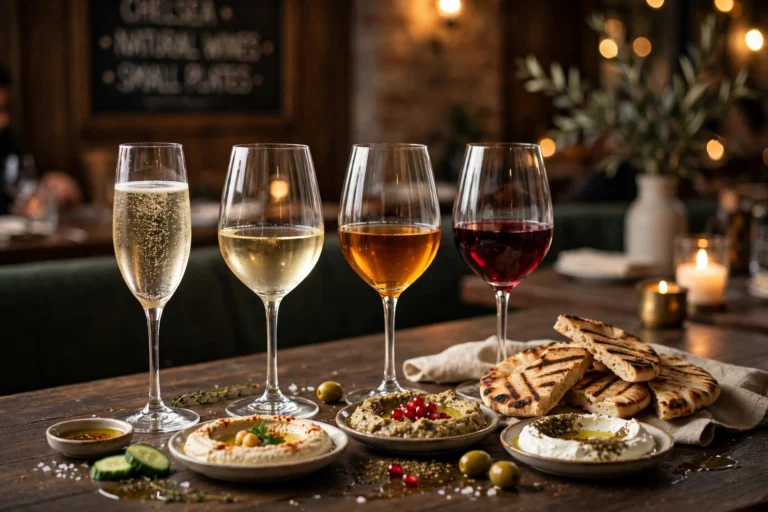
Open the Shukette menu and one phrase sits near the bread section like a set of instructions: rip and dip. It is the closest thing Shukette has to a mission statement — but it is not really a slogan at all. It is a literal description of how the kitchen wants you to eat. At chef Ayesha Nurdjaja‘s Chelsea restaurant, warm house-made bread is not a side dish that arrives while you wait for the real food. It is the utensil the whole meal is built around: torn by hand, folded, and pulled through a dip in one motion.
That single idea explains almost everything about a meal at Shukette — why the bread-and-dip section tops the menu, why the plates are built for sharing, and why the last piece of frena matters more at the end of the meal than at the start. Here is how rip-and-dip works, and how to do it properly.
A note on prices: Shukette’s menu does not list prices online, and dishes change with the seasons — check the restaurant’s current menu or ask your server for today’s prices before you order.
Rip-and-Dip at a Glance
| The basics | Details |
|---|---|
| The idea | House bread torn by hand and used to scoop dips, spreads and sauces — bread as the utensil |
| Where it appears | Printed near the bread section of the menu; the bread-and-dip section leads the menu |
| The breads | Frena, lafa, boureka, pita, chickpea flaxseed cracker |
| The dips | Not Your Average Hummus, labneh, spring pea dip, beet tzatziki, smoked Arctic char |
| The golden rule | Keep a piece of bread on the table from the first dip to the last sauce |
| Prices | Not listed online — confirm the restaurant’s current menu or ask your server |
| The setting | Shukette, 230 9th Ave, Chelsea — dinner only, shared plates, open kitchen with a 23-seat counter |
What “Rip-and-Dip” Actually Means
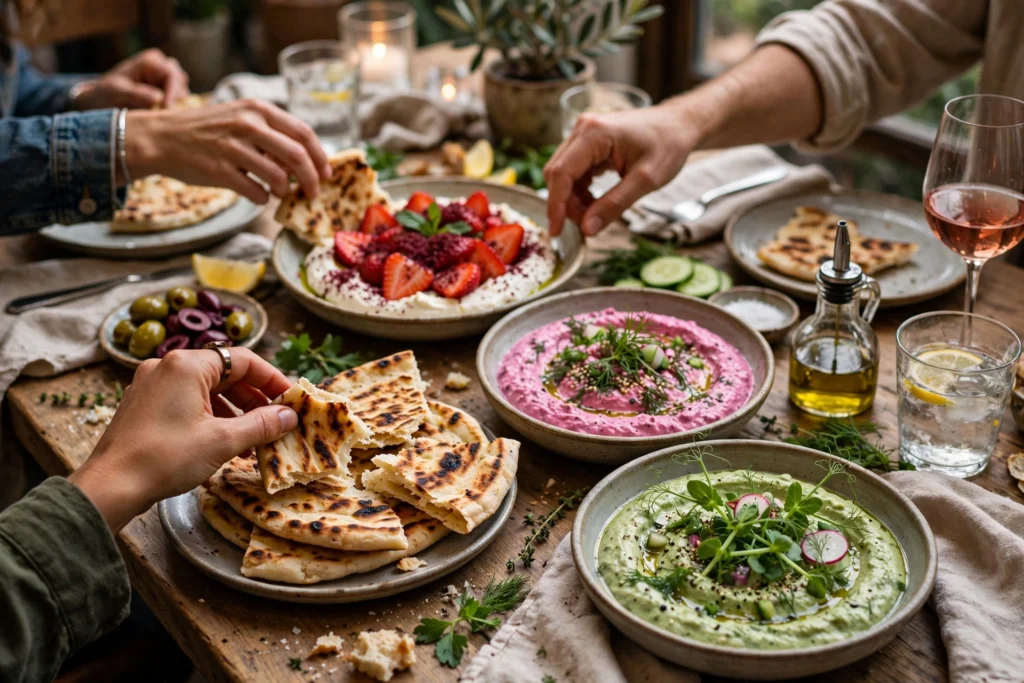
The phrase describes a physical way of eating. Bread at Shukette is baked to be handled: pillowy, warm, and sturdy enough to tear rather than slice. You pull off a piece, fold it once, and drag it through a dip — hummus, labneh, whatever is in front of you — in a single motion. No knife, no fork, no neat triangles cut in advance.
Because the bread is doing the work of a utensil, it behaves differently from a dinner roll: a torn edge has more surface and texture than a cut one, so it picks up more of the dip — and of everything else that lands on the table later. Rip-and-dip is not a starter course. It is the technique the rest of the menu assumes you are using.
Where It Comes From: Bread as the Utensil
The habit is much older than the restaurant. Across the Levant and the broader Eastern Mediterranean, warm bread has traditionally been used as the utensil itself rather than as an accompaniment — torn by hand, folded, and pulled through shared dips in one motion.
Nurdjaja built that habit directly into Shukette’s format. The menu is Levantine-inspired — drawing on Israeli, Syrian and Lebanese cooking — and the bread-and-dip ritual is its most everyday expression: food in the middle, bread in hand, nothing eaten alone.
Built Into the Menu, Not Added on Top
Most restaurants treat bread as a prelude. At Shukette, the bread-and-dip section sits at the very top of the menu, ahead of the Shuk section’s vegetable plates and the charcoal-grilled dishes of Al Ha’esh — a deliberate piece of menu architecture. Nurdjaja structured it so the first thing you order is the tool you will use for everything after it.
That placement changes how a meal runs. Dips arrive as the foundation, not a warm-up; the Shuk plates that follow are built to be eaten the same shared way; and when the grilled dishes arrive from the charcoal fire, the bread is still there, ready for its second job.
The Breads and Dips That Do the Work
The breads. Frena is the headliner: a Moroccan-style bread finished with garlic and oregano, soft inside and made for tearing. Lafa is a grilled flatbread brushed with ramp butter — thinner, with charred edges that hold up in a saucy dip. Boureka (sweet potato and goat cheese) is the richer, pastry-like option; the whole-wheat pita is the familiar standby; and the chickpea flaxseed cracker is the menu’s gluten-free option.
The dips. Not Your Average Hummus — topped with marinated chickpeas and bang bang shata — is the most requested, and the natural first order. Labneh is strained yogurt dressed with strawberries, pickled fennel and sumac: tangy, bright, the best contrast on the table. Beet tzatziki (roasted beets with yogurt, cumin and dill) is the more vivid option; the spring pea dip, with spring garlic, preserved lemon and mint, is the lightest; and smoked Arctic char, with smoked onion-garlic aioli, is the pick if your table wants something from the sea. Most of the dips are vegetarian — one reason the format works so naturally for mixed tables.
How Rip-and-Dip Changes the Way You Order
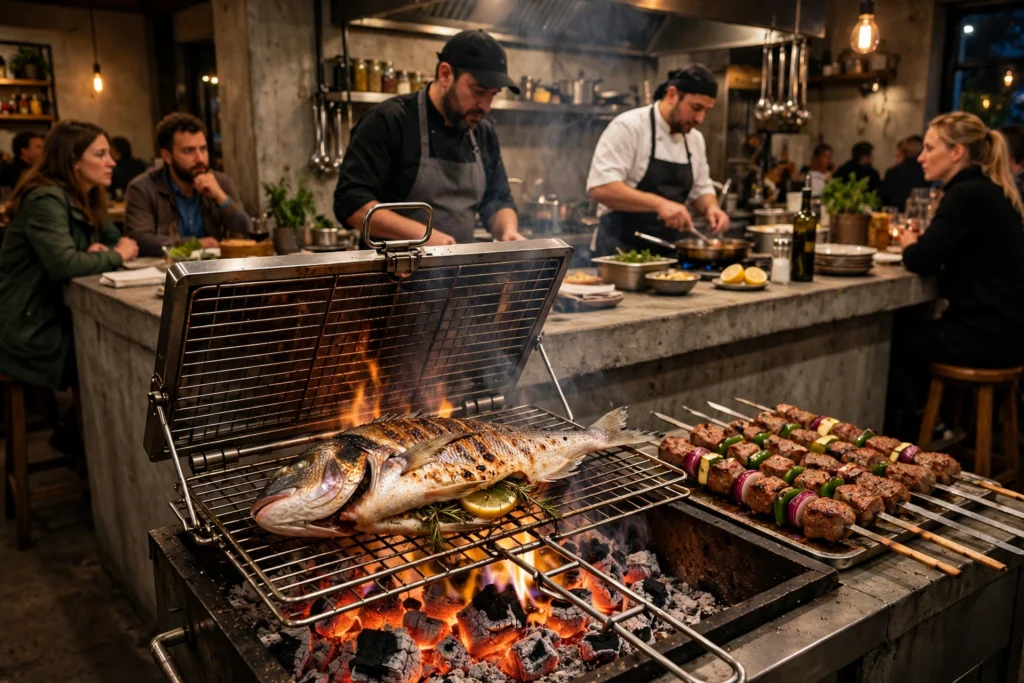
Here is the part first-timers miss: frena and lafa are not filler before the real meal. They are functional tools for everything that follows, well outside the dip section. When the Shrimp à la Plancha arrives in harissa butter, the last piece of bread is how that butter gets eaten. When the Fish in a Cage — a whole porgy from the charcoal grill — lands with its green charmoula, bread is how the sauce leaves the plate. Every Al Ha’esh dish, from Joojeh Chicken with toum to the steak shish kebab with carrot harissa, leaves something behind worth mopping up.
So order with the whole arc in mind: bread first, a dip or two, then Shuk plates, then something from the fire — and make sure the bread outlasts the ordering. Tables that finish their bread with the dips have nothing left for the best sauces of the night.
Rip-and-Dip at the Table: Five Practical Tips
- Order bread first — and keep ordering it. A piece of bread should stay on the table through the whole meal, not just at the start.
- Skip the fork for dips. Tearing and scooping by hand is the intended way, not the informal one. Nobody at Shukette will blink.
- Rotate two dips with one piece of bread. Fold one piece through both bowls rather than taking a fresh piece for each — you get the contrast, and the bread lasts.
- Save bread for the grill. The sauces on the Al Ha’esh dishes — harissa butter, charmoula, toum — are the best things bread will touch all night.
- Mind your sleeves. Hands-on eating over shared bowls — leave the treasured white shirt for another night.
Why It Works So Well for Groups
Rip-and-dip assumes shared plates and a communal bread basket from the first minute, so a group never hits the awkward moment of deciding what is individual and what is for the table. Everyone reaches for the same basket, and the ordering maths stays simple — the kitchen’s rule of thumb is roughly two to three dishes per person across breads, dips, Shuk plates and the grill. In a loud, high-energy room with a 23-seat counter wrapped around the open kitchen, it turns dinner into something closer to a shared project than a sequence of courses.
FAQs
What does “rip and dip” mean at Shukette?
It is the restaurant’s name for its way of eating: house-made bread torn by hand and used to scoop dips, spreads and sauces. The phrase is printed near the bread section of the menu, and the bread-and-dip section leads the menu itself.
Which bread should I order first?
Frena — the Moroccan-style bread with garlic and oregano — is the signature and the best all-rounder. Lafa, the grilled flatbread with ramp butter, is the pick if you like charred edges.
Are the dips vegetarian or vegan?
Most dips are vegetarian. The spring pea dip is the most dependable vegan choice; labneh and beet tzatziki are yogurt-based, so vegan diners should confirm the day’s preparation with their server. The chickpea flaxseed cracker is the gluten-free bread option.
How much bread and how many dips does a table need?
Start with one bread and one or two dips rather than all five — for two people that is plenty before the Shuk plates. Across the whole meal, plan on roughly two to three dishes per person.
How much does a meal at Shukette cost?
Shukette does not publish prices on its online menu, and third-party listings disagree with each other — so check the restaurant’s current menu or ask your server for today’s prices before you order.
Before You Go
Rip-and-dip is the key that unlocks Shukette: order the bread first, keep it on the table all night, and let it carry you from the first bowl of hummus to the last charcoal-grill sauce. Book on Resy if a table matters to you — walk-ins are pointed to the counter, which wraps the open kitchen and puts you closest to the fire. Shukette serves dinner only, Monday to Saturday 5pm–11pm and Sunday 4pm–10pm, at 230 9th Ave in Chelsea. There is no formal dress code — smart casual fits the room — and the cooking is seasonal, so dips and Shuk plates rotate. Go hungry, go with people who like to share, and save your best piece of frena for the fish.
Enjoying the menu guides?
Follow MenuExplore for daily restaurant menus & prices — know the menu before you go.